
This article is part 2 of 3 in a series about gracefully pivoting from SEO to AEO / AI Search marketing.
First, a quick recap from the first part of this three-part series. Last post I made the case that SEO is the foundation you pivot from, not something to be replaced in favor of AI Search / AEO / GEO. The main points that support this are 1. your keyword research is real and valuable market research, 2. we don’t have prompt-level data and can’t prioritize in a quantifiable way, 3. LLMs still lean heavily on web search (aka SEO results), and 4. Google will keep using SEO principles inside its AEO algorithm.
To summarize: abandoning or even taking attention away from SEO to chase AEO is self-sabotage.
This piece is about what to do next. How do you actually take a mature SEO program and evolve it into an AEO strategy?
Let’s get into that now.
Starting with a complete SEO foundation
The methodology and workflow I will share here assumes you already have a complete, organized set of SEO keywords that are relevant to your business. If you don’t, that’s where to start. Everything downstream (the prompts, the tracking, the content strategy) depends on having an organized map of how your customers search today. That map is what you’re about to extend into AEO.
If your team doesn’t yet have this or it’s incomplete, a partner can help you get to the starting line quickly. But don’t skip this step. Trying to do AEO without an SEO foundation is trying to pivot from something you don’t have. It’s critical that you not only have a complete set of SEO keywords, but that they are organized by unique user intent. I’ve outlined the concept of an Intent Group below and you’ll see why this is a critical configuration for pivoting to AEO.
Setting the baseline: from keywords to prompts
Before we get into Intent Groups, I should establish that the core measurement problem in AEO is that the unit of demand has changed. In SEO, the unit is a keyword. In AEO, it’s a prompt. And prompts are different animals: they’re longer, more conversational, more specific, often multi-part.
In addition to this, we don’t yet have prompt-volume data the way we have keyword-volume data, so we can’t just “look up the top prompts in my category.” What we can do, however, is proxy it, and the tool we use to do that is SEO keywords and the intent group. From this scaffolding we can use AI to generate prompts that are closely related to SEO keywords and thus can proxy the data related to those keywords.
What is an intent group?
An intent group is a cluster of SEO keywords that are all asking the same underlying question, just phrased differently. “New white tennis sneakers,” “white sneakers for tennis,” “best white tennis sneakers”: these are not three different questions. They’re one question asked three slightly different ways, and they deserve one answer. The reason is obvious once you see it: a single person might phrase the same question two different ways across a single day, depending on mood or context.
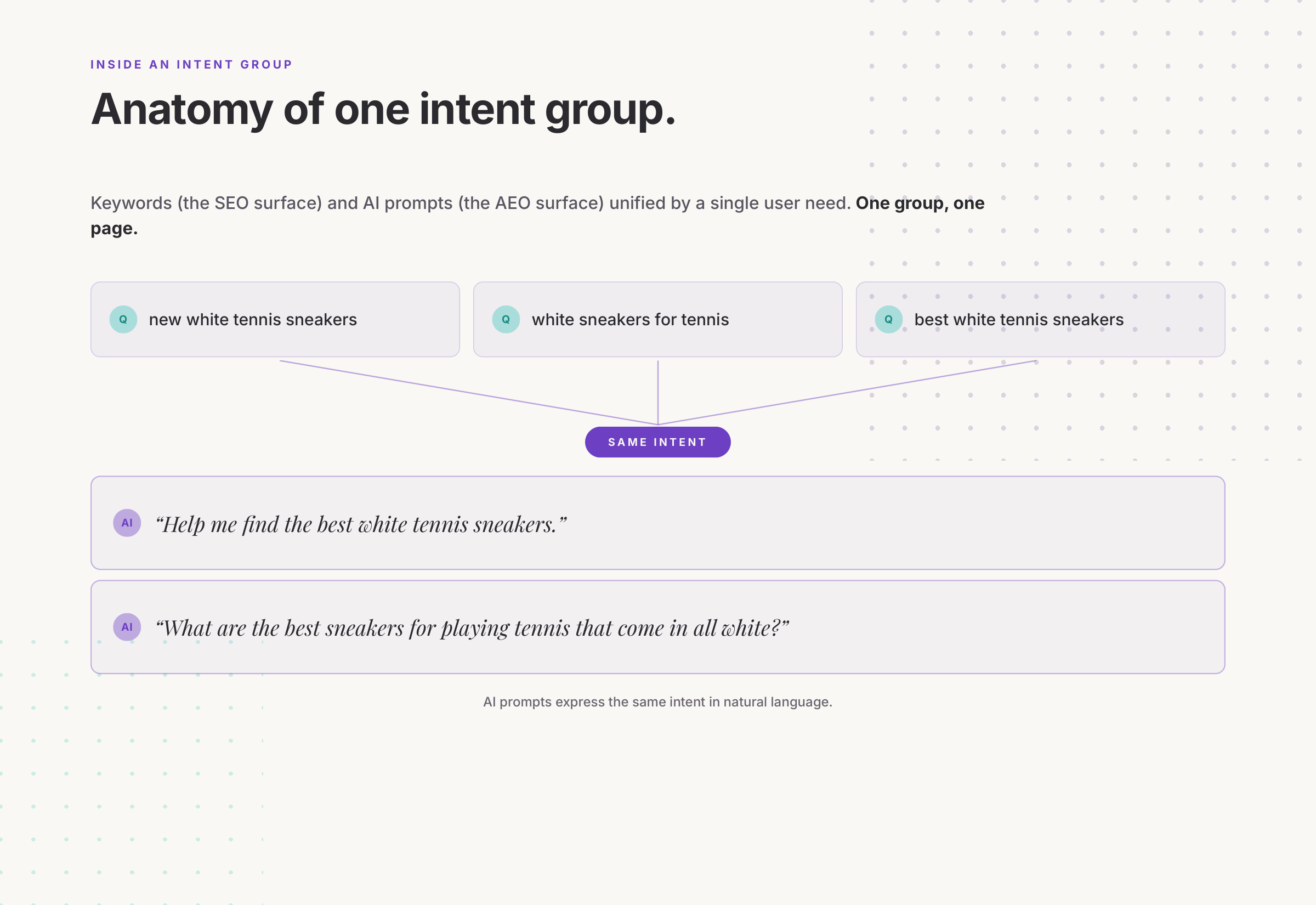
It is important to be very precise about where one intent group ends and another begins. “White tennis sneakers for clay courts” is not the same intent group as “white tennis sneakers.” If a prospect tells you they play on clay, you can’t ignore that and recommend all-court shoes; the nuance has to be honored. So intent groups need to be tightly bounded. Same exact intent, different phrasings. Anything else gets its own group.
Why intent groups are the bridge to AEO
Intent groups as a concept are so critical because intent is what transfers across SEO and AEO. A user who searches “best white tennis sneakers” on Google and a user who asks an LLM “help me find the best sneakers for playing tennis that come in all white” have the same general intent. The interface is different. The wording is different. The job to be done is identical.
So if you have your keywords grouped by intent, you now have a ready-made map of the prompts your customers are likely to use. You just need to translate SEO behavior into AI search behavior.
The workflow
-
Organize your keywords into intent groups. This is a careful, sometimes tedious exercise. You can use AI to help cluster them, but a human has to validate that each group reflects a single distinct intent.
-
Generate prompts from each intent group. We give the full set of keywords in an intent group to an AI and ask it to formulate one to three prompts that reflect the same intent in more conversational, long-winded language. The more keywords in the group, the clearer the intent signal gets, and the better the prompts become. However, don’t group keywords that don’t truly share the same unique intent. We have several intent groups that only contain 1 - 2 keywords and that’s ok.
-
Recommend three prompts per group. Prompts vary widely even when the intent is identical. Three variations give you measurement resilience so you’re not at the mercy of a single phrasing floating in or out of a result.
-
Put those prompts into an AEO tracker. These tools work like SEO keyword trackers: a machine acts as a user, runs the prompt against the major AI search tools on a schedule, and records whether your brand appears. You now have a baseline.
That’s the end of the baseline work. You have keywords in your SEO tracker, prompts in your AEO tracker, and both are tied to the same intent groups. Now you can start moving the numbers.
Tactics: what to actually change
These are the tactics we’re deploying. Some are well-established SEO practices that still pay off; some are newer and still being validated. We have blended established SEO tactics with emerging AEO tactics because we find you can optimize both at once effectively.
1. Unique content for every intent group
This is the biggest lever, and it’s non-negotiable. Every intent group needs its own page at its own URL. Search engines still rely heavily on one-to-one matching between a query and a page, signaled through the title tag and H1. One page answering one intent group is the cleanest signal you can send.
Could an LLM, in theory, read a single giant page covering ten intent groups and pull out the right answer? Yes. But a search engine is far more mechanical about this. If SEO still matters (and we’ve established that it does), you need dedicated pages. Since most users will default to Google search for at least the next year or two or more, the order of operations is: optimize for SEO, and AEO follows. A page that’s optimized for SEO is, de facto, more findable by the LLMs that lean on web results.
To prep these pages for AI search, make sure they also use Schema markup so that an LLM understands the structure of the content and can more easily pull a citation.
2. An llms.txt file
An llms.txt file is a single document that points LLMs toward all of your key SEO/AEO pages. Think of it as a sitemap, but designed specifically for AI crawlers. It’s a low-cost tactic with plausible upside: you’re making it easier for LLMs to find and index your content as a coherent set. This is experimental, but experimentation is the point.
3. A comprehensive FAQ page with schema markup
We’re seeing promising results with a single, large FAQ page that addresses every intent group in a structured question-and-answer format, marked up with FAQ schema. Schema markup is no longer a nice-to-have. It’s becoming the standard way to tell an LLM what the different parts of a page are: “here’s a question, here’s the answer, here’s a list, here’s a citation.” Instead of forcing the model to infer structure, you hand it to them explicitly.
Schema was always a good idea for search engines. It’s more critical now because LLMs are reading entire pages and need help parsing them. Mark up your intent-group pages and your FAQ.
4. Targeted backlinks to specific pages
SEO backlinks still drive search engine rankings, and search engine rankings still influence LLM visibility. We continue to see success supporting specific pages with backlinks where those pages are weak in SEO visibility. And there’s a reasonable hypothesis that third-party references directly influence AEO. LLMs appear to use quality signals that closely resemble, or are directly proxied from, SEO authority signals.
Even if an LLM doesn’t read backlinks directly, it’s almost certainly reading Google’s ranking of your page, and that ranking is influenced by backlinks. Either way, the tactic pays.
The through-line
Every tactic here has the same shape: what’s good for SEO is good for AEO, so lead with SEO and let AEO benefit. Unique pages per intent group, schema markup, high-quality backlinks, well-organized content: these are SEO fundamentals. The AEO gain is that LLMs are increasingly reading the same signals.
You set the baseline, you deploy the tactics, and then comes the hard part: figuring out what’s actually working in a landscape with no playbook. That’s Part 3.
Next: How to measure AEO when there’s no analytics dashboard, no established playbook, and a lot of people claiming they have the magic formula.