The Problem With Keywords Alone
Keywords tell us what people type. They don’t tell us what people actually want.
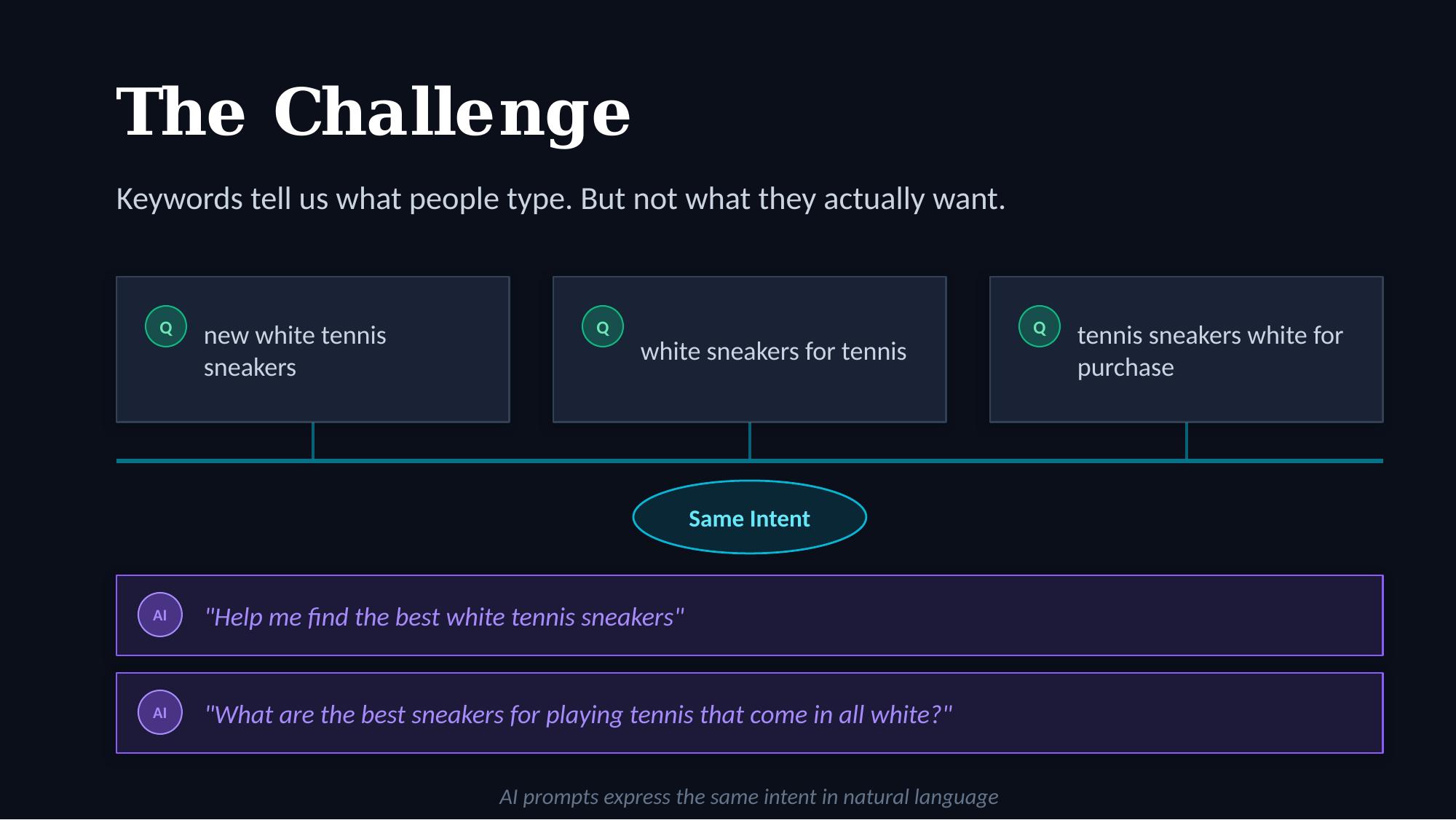
Consider these three searches: “new white tennis sneakers,” “white sneakers for tennis,” and “tennis sneakers white for purchase.” They look like three different keywords. They show up as three different rows in a spreadsheet. But they all express the same underlying need — someone wants to find and buy white tennis sneakers.
Now layer in AI search. A user might ask ChatGPT: “Help me find the best white tennis sneakers” or prompt Perplexity with “What are the best sneakers for playing tennis that come in all white?” Same intent again, just expressed in natural language instead of keyword shorthand.
Traditional SEO treats every keyword as a separate target. That approach creates three problems: you end up with multiple pages competing against each other for the same intent, you can’t measure performance in any meaningful way because your data is scattered across hundreds of individual keyword rankings, and you have no framework for connecting SEO keywords to AI prompts — which is exactly the connection that matters most right now.
What Is an Intent Group?
An Intent Group is a cluster of keywords and AI prompts that all express the same underlying user need. It’s the organizing unit that sits between your audience segments (broad) and your individual keywords (granular).
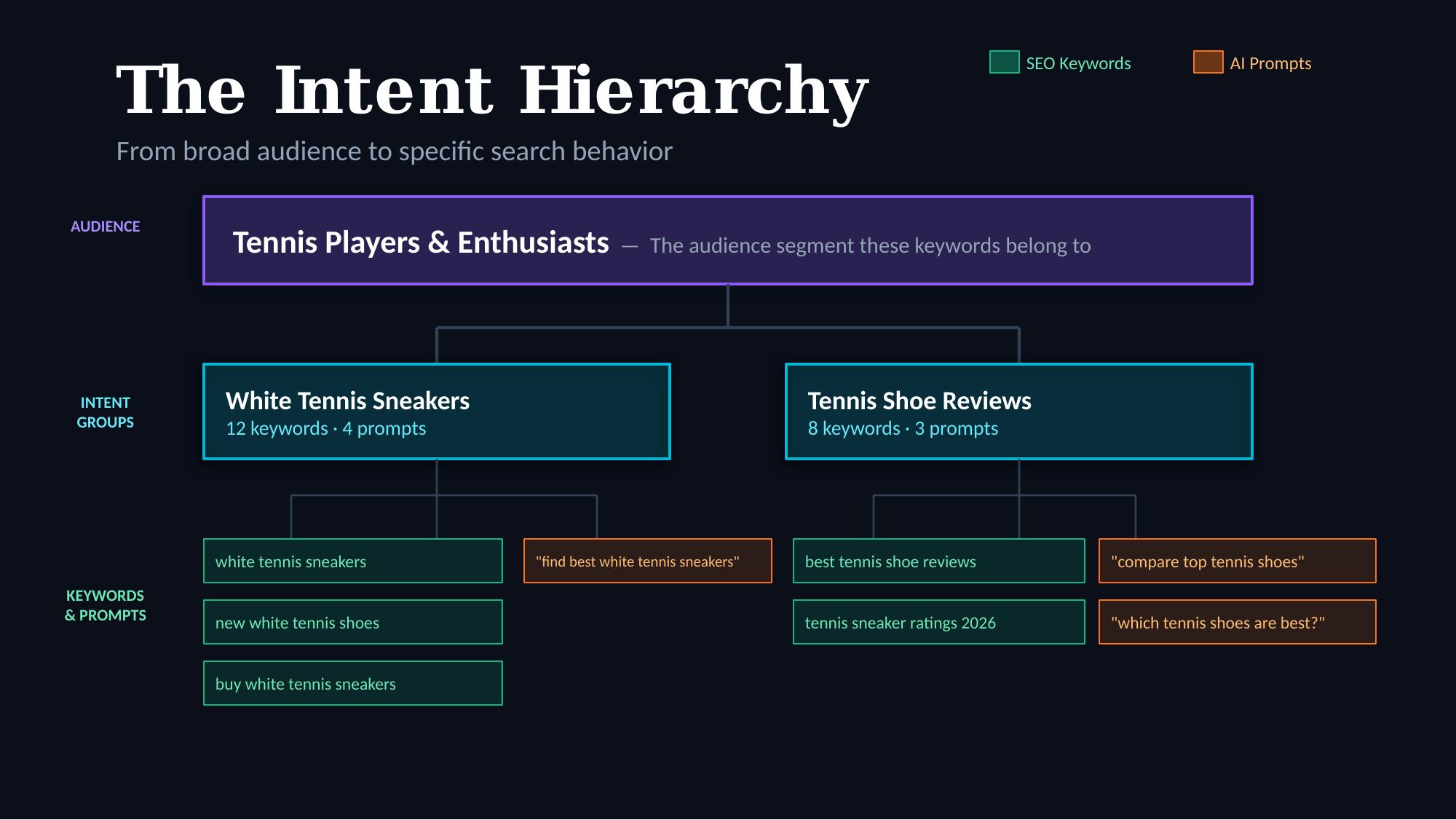
Think of it this way: an audience segment like “Tennis Players & Enthusiasts” tells you who you’re talking to. An intent group like “White Tennis Sneakers” tells you what a subset of that audience is actually looking for. And the keywords and prompts within that group — “white tennis sneakers,” “new white tennis shoes,” “buy white tennis sneakers,” “Help me find the best white tennis sneakers” — are just the different ways people express that same need.
This structure solves three things at once. First, it gives you a focused strategy: one page per intent group means you’re never competing with yourself. Second, it provides clearer measurement: tracking performance at the intent level is far more useful than watching hundreds of individual keyword positions. Third, it makes your strategy AI-ready: grouping SEO keywords alongside the AI prompts that express the same intent creates a unified view of how users find you across both traditional search and AI search.
The Intent Hierarchy
The model works in three layers, from broad to specific.
At the top, Audiences represent the segments your business serves — the people you’re trying to reach. This is the strategic layer where CMOs and marketing directors operate.
In the middle, Intent Groups represent the specific things those audiences are searching for. Each intent group captures a distinct user need and becomes the focal point for a page on your site, a tracking project in your analytics, and a set of optimization targets.
At the bottom, Keywords & Prompts are the individual search queries and AI prompts that belong to each intent group. These are what practitioners work with day to day, but they’re always connected upward to the intent group they belong to.
For example, the audience “Tennis Players & Enthusiasts” might contain intent groups like “White Tennis Sneakers” (12 keywords, 4 prompts) and “Tennis Shoe Reviews” (8 keywords, 3 prompts). Each of those intent groups then contains the specific keywords and prompts that express that need.
Inside an Intent Group
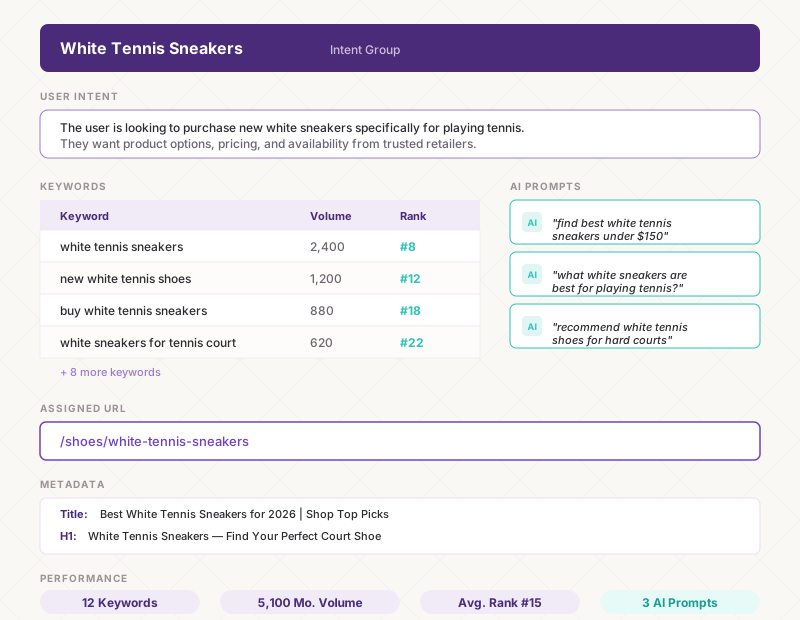
Each intent group is a self-contained unit that holds everything you need to optimize for a single user intent.
User Intent Statement — A plain-language description of what the user is trying to accomplish. For “White Tennis Sneakers,” this might be: “The user is looking to purchase new white sneakers specifically for playing tennis. They want product options, pricing, and availability from trusted retailers.”
Keywords — All the SEO keywords that express this intent, along with their search volume and current ranking position. A group might contain 8 to 20+ keywords ranging from high-volume head terms to specific long-tail variations.
AI Prompts — The natural language prompts users might use with LLMs to express the same intent. These are tracked separately because AI search behavior differs from traditional keyword search, but they’re housed under the same intent group because the underlying need is identical.
Assigned URL — The single page on your website that’s responsible for this intent group. It might be an existing page or one that needs to be created. Either way, every keyword and prompt in the group points to this one URL.
Metadata — The optimized SEO title, meta description, and H1 for the assigned page, all crafted to serve the intent group as a whole rather than any single keyword within it.
Performance Summary — Rolled-up metrics for the group: total keyword count, combined search volume, average ranking position, and number of tracked prompts.
Why Intent Groups Change Everything
Without intent groups, SEO strategy tends to feel scattered and reactive. You’re looking at hundreds of keywords with no structure, multiple pages competing for the same intent, no connection between SEO and AI search, and performance data that’s hard to act on because it’s too granular.
With intent groups, the picture sharpens. Keywords are organized by real user needs. Each intent gets one focused page, eliminating cannibalization. SEO keywords and AI prompts are unified under one roof. And performance tracking happens at the intent level, where it’s actually meaningful.
The difference isn’t just organizational — it changes how decisions get made. When you see that an intent group with 5,100 combined monthly search volume is ranking at an average position of 15, you have a clear, actionable signal. You know the opportunity, you know the gap, and you know exactly which page to improve.
Intent Groups Power Your Entire Strategy
Each intent group becomes the unit of action across every aspect of your search program.
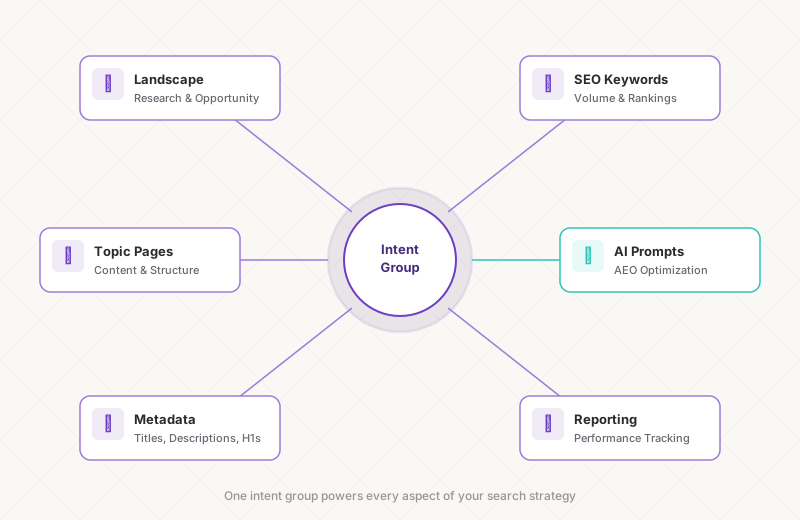
Landscape & Research — Intent groups are how you map the universe of user demand. Instead of a flat list of thousands of keywords, you have structured clusters that show you which needs are covered, which are underserved, and where the biggest opportunities exist.
Content & Pages — Each intent group corresponds to a page. This drives content creation with clear purpose — you’re not writing pages for keywords, you’re building pages that serve specific user needs.
SEO Optimization — Keywords within each group inform your title tags, headers, and on-page content. Because they all express the same intent, the optimization strategy is coherent rather than trying to serve conflicting signals.
AI & Prompt Optimization — The prompts in each group tell you how users are asking LLMs about this topic. This informs the depth of content, FAQ structure, and the specific questions your page needs to answer to get cited in AI responses.
Tracking & Reporting — Performance is measured at the intent group level. Instead of reporting on hundreds of individual keyword movements, you’re tracking whether you’re winning or losing for each distinct user need.
Performance Reporting — Intent groups let you roll up results in a way that connects to business outcomes. An audience segment contains intent groups, each with a combined volume and average position — giving leadership a clear view of progress without drowning in keyword-level data.
The Key Takeaway
Intent Groups are the single organizing principle of your SEO and AEO strategy. Every keyword, every AI prompt, every page, every optimization recommendation, and every performance metric connects back to an intent group.
Master your intent groups, and you master your search presence — across both traditional search and AI.